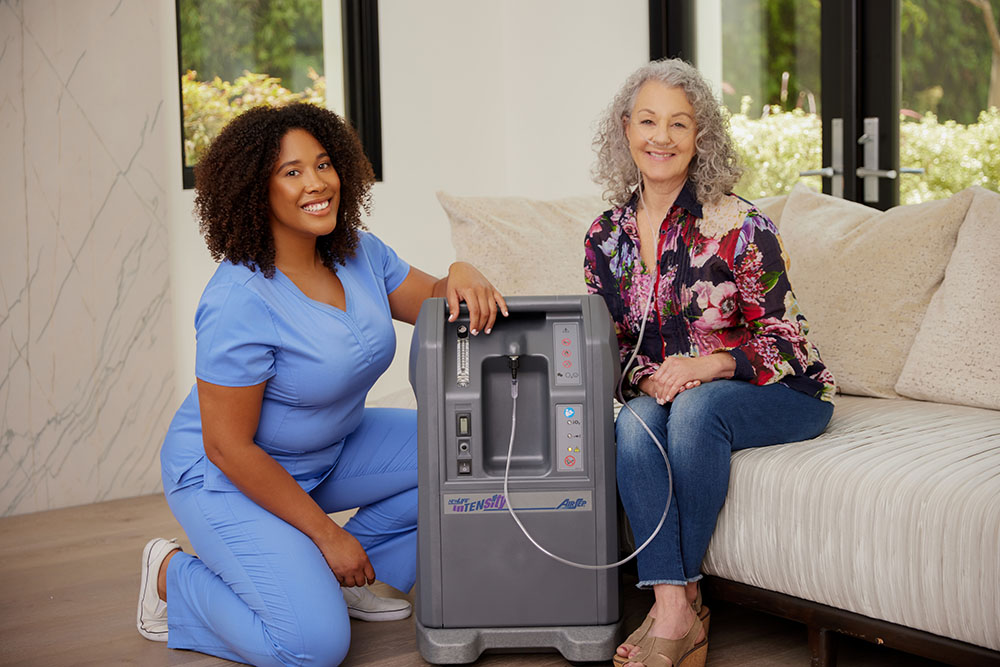
In this article, we’ll break down what POCs are, how they work, who they are best suited for, key considerations before switching, and important questions to ask your clinician.
Learn more about Lincare’s available options here: Portable Oxygen Concentrators
What Is a Portable Oxygen Concentrator (POC)?
A portable oxygen concentrator is a medical device that takes in surrounding air, removes nitrogen, and delivers concentrated oxygen to help maintain healthy oxygen saturation. It operates using two primary oxygen‑delivery methods: continuous flow and pulse‑dose (on‑demand) delivery1.
POCs are designed to be smaller and lighter than stationary home concentrators, making them usable both indoors and on the go. Most POCs deliver oxygen in pulse‑dose mode, releasing oxygen only upon inhalation2. Some modern POC models also offer continuous‑flow capability, which may be necessary for patients with certain activity levels or nighttime oxygen needs.
Potential Benefits of Portable Oxygen Concentrators
- Improved mobility and independence: POCs operate on rechargeable batteries and are engineered for portability, they may help patients stay active, complete daily tasks, and participate in social activities with fewer limitations3. Pulse‑dose units are typically lighter and more efficient, conserving oxygen by delivering it only during inhalation4.
- Reduced reliance on heavy tanks: By eliminating the need to transport large cylinders or schedule frequent refills, POCs can help simplify oxygen therapy routines and support health-related quality of life5.
- Travel readiness, including air travel: Many POCs are approved by the Federal Aviation Administration (FAA) for use during flights, enabling patients to travel more freely.
Learn more here: Flying with Your Portable Oxygen Concentrator.
Key Considerations Before Switching6
POCs are not a universal solution for every oxygen user. The following factors are important to consider before discussing transitioning with your prescribing provider:
- Oxygen delivery needs differ by patient: Most POCs use pulse‑dose, which may not provide adequate oxygen for individuals who require higher continuous-flow rates.
- Confirm your prescribed flow rate: Your healthcare provider will assess whether your medical needs, including activity levels, breath patterns, or nighttime requirements, are compatible with pulse‑dose or if continuous flow is necessary.
- Daily activity planning: Consider how much time you spend walking, traveling, or in environments without power access. Pulse‑dose delivery adjusts with changes in respiratory rate (e.g., during exertion), but performance can vary across devices.
- Battery life and backup options: Since portability depends on battery power, make sure the device’s runtime aligns with your lifestyle. Keeping spare batteries or a charging plan is necessary, especially for extended outings.
When a Portable Option May Make Sense
POCs may be a strong fit for:
- Patients with lower oxygen flow requirements, which are more easily supported by pulse‑dose systems7.
- Individuals who are looking to maintain an active lifestyle or frequently leave home.
- Those capable of meeting oxygen saturation targets under a clinician’s evaluation, often using pulse oximetry during rest and activity8.
However, individuals with sleep‑related desaturation, those needing higher output, or those who do not trigger pulse sensors effectively may still require stationary or continuous‑flow units.
Some Questions You May Want to Ask Your Healthcare Provider
Consider bringing these questions to your next appointment:
- What is my prescribed oxygen flow rate, and can a portable device meet it?
- Do I require continuous flow for sleep or activities, or is pulse‑dose sufficient?
- What battery life should I expect based on my usage?
- Are there specific POC models suited to my activity level and travel needs?
- What safety tips should I follow when using a POC away from home?
Practical Tips for Using a Portable Concentrator Safely and Effectively9
Consider bringing these questions to your next appointment:
- Follow manufacturer and healthcare provider instructions on maintenance, tubing, filter care, and battery management.
- Practice using the POC on walks or short outings to see how it supports your oxygen levels during activity.
- Carry backup batteries and plan for charging access when traveling or spending long hours away from home.
- Maintain hydration and nasal comfort, as oxygen therapy may cause dryness.
Portable oxygen concentrators may enhance independence and health-related quality of life for many patients. However, they are not one‑size‑fits‑all, and the right device should always align with your clinical oxygen requirements, lifestyle, and safety needs.
Your clinician is the best guide in determining whether a POC is appropriate.
To explore Lincare’s full range of home oxygen therapy options and get personalized support, visit: Home Oxygen Therapy, Oxygen Supplies & Equipment.
Disclaimer: The content on this blog is for informational and educational purposes only and should not replace professional medical advice, diagnosis, or treatment. Always consult your healthcare provider for guidance on your specific health needs.
1. https://www.lung.org/lung-health-diseases/lung-procedures-and-tests/oxygen-therapy/getting-started-portable-oxygen-concentrator/
2. https://scienceinsights.org/whats-the-difference-between-pulse-dose-continuous-flow-oxygen/
3. https://scienceinsights.org/whats-the-difference-between-pulse-dose-continuous-flow-oxygen/
4. https://scienceinsights.org/whats-the-difference-between-pulse-dose-continuous-flow-oxygen/
5. https://respiratory-therapy.com/disorders-diseases/critical-care/ards/making-sure-that-smaller-is-bettermatching-therapeutic-standards-with-shrinking-oxygen-systems/
6. https://www.homecaremag.com/portable-oxygen-concentrators-enhance-mobility-independence/
7.https://scienceinsights.org/whats-the-difference-between-pulse-dose-continuous-flow-oxygen/
8. https://document.resmed.com/en-us/documents/products/oxygen/Mobi/fact-sheet/mobi_pulse-vs-continuous_fact-sheet_amer_eng.pdf
9. https://www.ncoa.org/article/safety-tips-for-using-supplemental-oxygen/